

PSHE including RSE

RSE stands for Relationships and Sex Education. PSHE stands for Personal, Social, Health and Economic education and often includes Citizenship. Together, RSE & PSHE support pupils to understand themselves, their relationships with others and the world around them. Through this learning, pupils develop the knowledge and skills needed to build healthy relationships, care for physical and mental wellbeing, understand their role in society and stay safe in a range of situations, including online.
PSHE and Relationships Education are central to our curriculum. Kapow Primary’s RSE & PSHE scheme aims to equip children with the knowledge, skills and attitudes they need to navigate the complexities of life in the 21st century. It is designed to support pupils in making informed choices about their health, safety, wellbeing and relationships, enabling them to become confident, thoughtful and active members of society.
The scheme includes wider PSHE learning, in line with the National curriculum (2014) requirement that schools make provision for personal, social, health and economic education. This includes non-statutory Citizenship content, which supports pupils in developing an understanding of rules, rights and responsibilities, democracy, fairness and participation in their communities. Together, this learning makes a strong contribution to pupils’ personal development as outlined in the Ofsted Inspection Framework and explicitly promotes the fundamental British values of democracy, the rule of law, respect and tolerance and individual liberty.
Programme of Study from September 2026
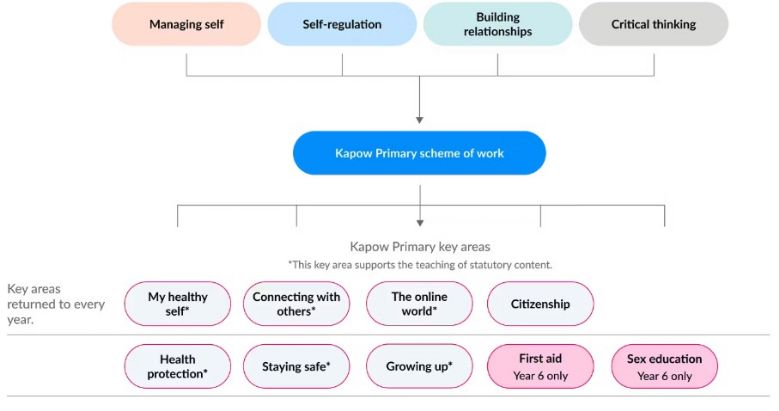
The Kapow PSHE and RSE lessons are categorised into the nine key areas below, which are returned to in each year group, making pupils’ prior and future learning clear and showing how what is taught fits into their wider learning journey. Year 6 also has a non-statutory unit on Sex Education.
Nine Key Areas:
- My Heathy self
- Connecting with others
- The online world
- Staying safe
- Health protection
- Growing up
- Citizenship (non-statutory at present; included in the forthcoming National Curriculum from September 2028)
- Sex Education (Year 6 only and non-statutory)
- First Aid (non-statutory)
Teaching and Learning
Kapow Primary’s RSE and PSHE scheme of work has been designed as a spiral curriculum with the following key principles in mind:
✓ Cyclical: Pupils revisit the five key areas throughout KS1 and KS2.
✓ Increasing depth: Each time a key area is revisited, it is covered with greater depth and increasing maturity.
✓ Prior knowledge: Upon returning to each key area, prior knowledge is utilised so pupils can build on previous foundations, rather than starting again.
Working with Parents and Their Right to Withdraw:
Primary schools are not required to teach Sex education. However, statutory guidance recommends that schools teach Sex education in Year 5 and/or Year 6, alongside learning about conception and birth, which is included within the Science National curriculum. We have chosen to teach Sex education in Year 6. At Southfields, we strongly believe that all children should have access to our Sex education programme.
Pupils will learn the correct names for body parts (including penis, vulva, vagina, testicles, nipples, scrotum). These specific vocabulary are statutory and cannot be withdrawn from.
Parents and carers have the right to withdraw their child from non-statutory Sex education, even where we have chosen to teach it. Parents will be informed via Class Dojo when their child is soon to receive their Sex education lesson. If you wish to withdraw your child, please inform your child’s class teacher in the first instance so that we can provide alternative education.
Parents/carers can see the resources used to teach the relationship and health education aspects of RSE in school by making a request to a member of the Senior Leadership Team.
Please take a look at the Kapow 'Parent Zone' for any FAQs. https://www.kapowprimary.com/subjects/rse-pshe/curriculum/rse-pshe-parent-information/
The PSHE/RSE Policy is available here.